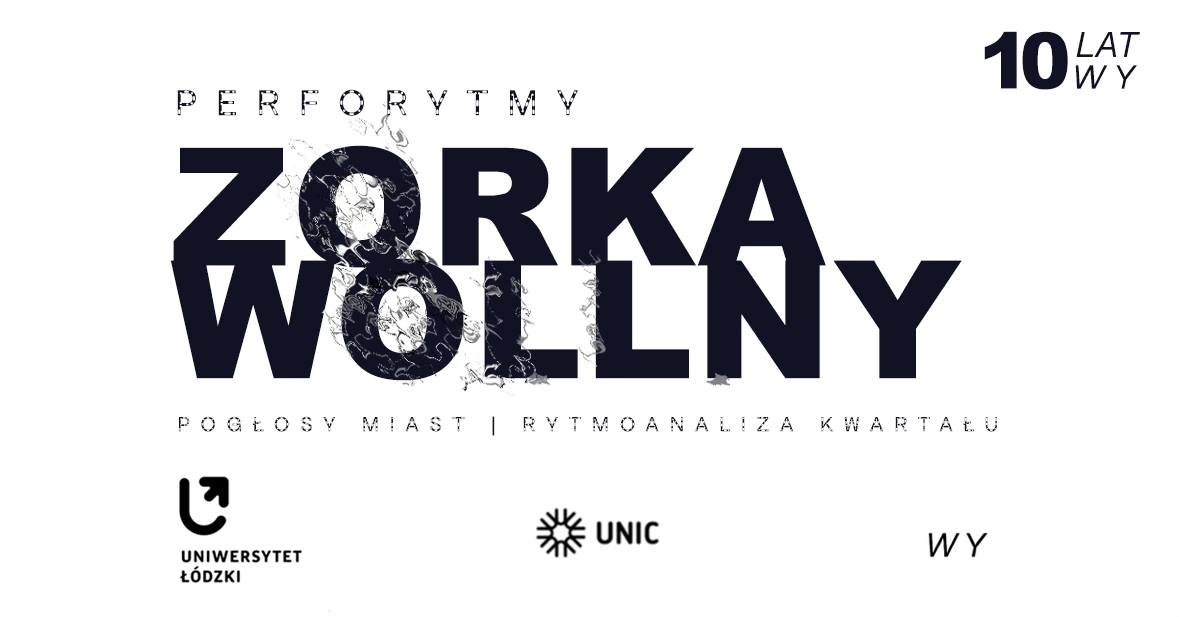
The area enclosed by Włókiennicza, Jaracza and Wschodnia Streets and Majewski Passage is a fragment of Łódź where revitalisation policies collide with local habits and the everyday struggle for space. Here, promises of a “new beginning” overlap with the persistence of long‑standing patterns of urban use. What, then, does a revitalised city block sound like? Is it primarily its façade that changes, or also the rhythms of everyday life – ways of moving, working and resting?
Rhythmanalysis of a City Block
For one month, students of International Cultural Studies at the University of Lodz conducted a rhythmanalysis in this block – a study of time and everyday life in the city, rooted in the work of Henri Lefebvre and Catherine Régulier. The research was carried out under the supervision of Dr Justyna Anders‑Morawska. Observations conducted at different times of day and week resulted in a record of pedestrian and vehicular flows, fluctuations in noise levels, moments of silence, the rhythms of opening and closing shops, and shifts between working time and private time. The researchers’ own embodied experiences: walking pace, fatigue, a sense of safety, reactions to temperature, smells and the texture of pavements were equally important. The collected notes, photographs and recordings made it possible to identify both recurring, predictable rhythms and moments of arrhythmia – instances of disruption, conflict and exclusion. The concept of micro‑performances: targeted interventions embedded in the existing rhythms of a place, which momentarily amplify or destabilise its routine emerged from this experience
Zorka Wollny
A performance by dr hab. Zorka Wollny, Associate Professor at the Academy of Art in Szczecin – an interdisciplinary artist whose practice for over two decades has consistently brought together visual arts, theatre, contemporary music and social activism, is at the centre of the event. The artist creates site‑specific performative works for factories, museums, theatres and abandoned buildings, engaging musicians, actors, dancers and members of local communities. In her projects, architecture is neither a backdrop nor a stage set, but a fully-fledged partner: it defines the conditions of hearing, movement and togetherness, while also revealing hierarchies, divisions and exclusions. Voice and body become tools of public expression, while performance serves as a means of exposing tensions between work and rest, visibility and invisibility, individual experience and the collective voice
Wollny’s projects have been presented, among other things, at the Steirischer Herbst Festival, the Chicago Architecture Biennial, Hebbel am Ufer Theatre and the CTM Festival in Berlin, De Appel in Amsterdam, the Institute of Contemporary Arts in London and the Akademie der Künste in Berlin. She received the Foundation for Music and the Arts Award in Dresden for her integration of music and visual arts in 2022 and in 2023, Kunsthaus Dresden hosted her retrospective exhibition Voices/Stimmen.
Rhythmanalysis and performance converge at a single point: both practices reveal how systems – design, regulations and market logic – organise people’s movement, presence and voice in space, often beyond their conscious awareness.
Discussion
The event will conclude with an open discussion exploring the following questions: What can we learn from listening to the rhythms of the city? What do everyday rhythms tell us about revitalisation that indicators and reports fail to capture? How can artistic practice open up new ways of thinking about the city – not only as an urban planning project, but as a living, contested and shared space?
The event is organised as part of the “Resonant Cities: Co‑listening to the Post‑industrial Past and the Sonic Future” project, carried out within the framework of UNIC ScienceHub in cooperation with the local partner Galeria WY and researchers from the University College Cork.
27 April 2026, 5:30 p.m. Galeria WY, Wschodnia 54 (entarnce from Włókiennicza), Łódź
Source: Dr Justyna Anders-Morawska
Edit: Centre for Organising Cultural Events and Conferences, University of Lodz