Can cities support the health of their residents?
Cities are more and more often becoming places where the most important challenges of our time – health, environmental and social – intersect. It is increasingly clear that the health of residents depends not only on the healthcare system but also on air quality, access to green spaces, spatial design and the organisation of urban life.
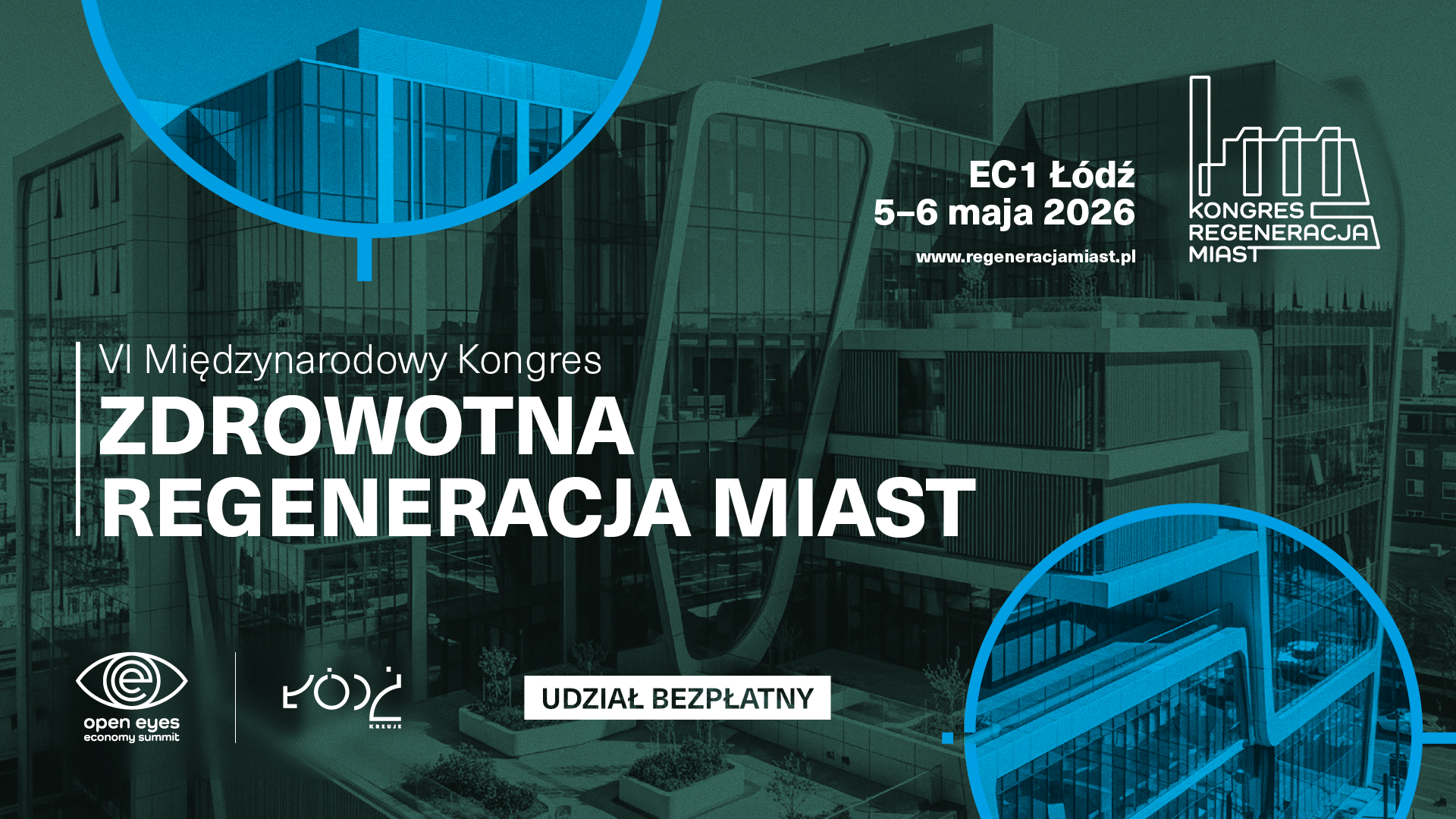
The 6th International Healthy Urban Regeneration Congress will be dedicated to these interdependencies. The event programme has been published and registration for the Congress, which will be held on 5- 6 May 2026, at EC1 Łódź – City of Culture, is now open.
The Congress is a part of a series of debates devoted to the future of cities and their capacity for regeneration in the face of contemporary crises – climate, social and demographic. Successive editions of the event have addressed various dimensions of this transformation: from the regeneration of industrial cities, through climate and energy regeneration, to digital urban regeneration.
This year's edition focuses on the relationship between cities and human health. Health is understood as physical, mental and social well-being, shaped by the quality of the urban environment, public spaces, the availability of services, and social relationships. The starting point is the belief that decisions regarding urban space, infrastructure and the natural environment have a direct impact on the quality of life of residents.
From the city microbiome to artificial intelligence
The programme of the event includes several thematic sessions that show how broadly we should understand the health urban regeneration today.
The most important topics include:
- urban microbiome and its impact on residents' health,
- air quality and urban ventilation planning,
- preventing lifestyle diseases through spatial design,
- the use of new technologies and artificial intelligence in healthcare,
- the importance of blue-green infrastructure for residents' well-being,
- the role of art and design in creating a healthier living environment.
Discussions will focus on both scientific research and the practical experiences of cities, public institutions, as well as public health organisations.
The programme also includes an Oxford debate for students from Łódź universities and meetings with representatives of the medical and scientific communities.
International speakers
The Congress will feature experts from Poland and abroad representing international organisations, the scientific community, the healthcare sector and businesses.
Confirmed speakers include:
- Michele Cecchini – Organisation for Economic Co-operation and Development (OECD),
- Karin Huber-Heim – Executive Director, Circular Economy Forum Austria,
- Anna Rulkiewicz – President at LUX MED,
- Andrzej Guła – President of the Management Board, Polish Smog Alert,
- Aleksandra Lewandowska – National Consultant in Child and Adolescent Psychiatry,
- Joanna Gutral – Cognitive-behavioural psychotherapist / Creator of the Gutral Gada psychoeducational podcast,
- Adam Wieczorek – Vice-Mayor of the City of Lodz,
- Iwona Maroszyńska – Director of the Polish Mother's Health Center Institute,
- Tomasz Karauda – University Clinical Hospital No. 1 named after Norbert Barlicki in Łódź,
- Catherine Vilquin – President of the European Council of Spatial Planners.
The event will also be attended by representatives of international organisations, universities, the medical and business communities and students of universities from Łódź.
About the event
The congress is organised by Open Eyes Economy, the GAP Foundation, and the City of Lodz. The event is co-organised by the University of Lodz and the Lodz University of Technology.
Registration is now open. A detailed programme is available on the event website.